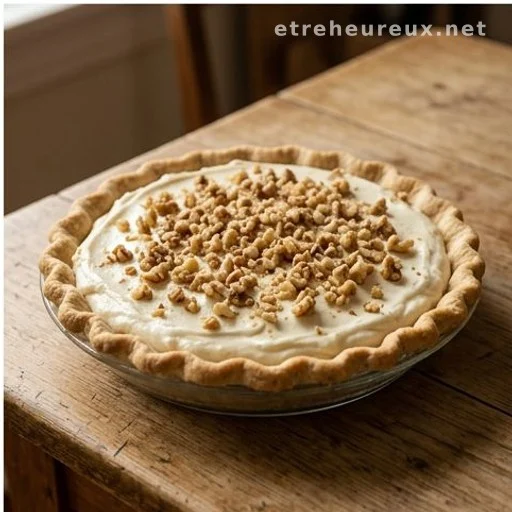
The author, who describes herself as 73 and living alone, frames the pie as a practical answer to a specific frustration — the desire for a rich, creamy dessert without the trouble of temperamental meringues or fillings that weep and separate after a few hours in the fridge.
Stovetop custard pies: a long-standing American tradition
Cream pies thickened with cornstarch and egg yolks have been a fixture of American home baking for generations, appearing regularly at church potlucks and family reunions across the Midwest and South — the settings the author explicitly references. The technique of tempering egg yolks is standard in custard preparation and predates modern convenience products by well over a century.
The technique: cornstarch, tempering, and why the filling sets cleanly
The filling is built around two principles the author describes as kitchen science. Whisking cornstarch together with the sugar before any liquid is added prevents lumps from forming — a standard step in stovetop custard work.

The second step is tempering: warm milk is added gradually to the egg yolks to raise their temperature slowly, avoiding scrambling. The author describes the result as a smooth, stable emulsion that sets in the refrigerator without weeping or turning watery.
The five core ingredients are a pre-baked 9-inch pie crust, one and a half cups of chopped walnuts divided between the filling and the topping, three-quarters of a cup of granulated sugar combined with a quarter cup of cornstarch, two cups of whole milk or half-and-half, and three large egg yolks. The source notes that the crust must be fully cooled before the filling is poured in.
Walnuts as an Omega-3 source: what the recipe claims
The author positions the walnut content as a nutritional argument in favor of the dessert. Walnuts, she writes, are one of the best plant-based sources of Alpha-Linolenic Acid (ALA), a type of Omega-3 fatty acid she associates with reducing systemic inflammation and supporting flexible blood vessel walls.